Privacy by Design
How do you develop software that complies with the GDPR? In this blog, you'll discover the eight principles of Privacy by Design and learn how to protect personal data from the start.

A few years ago, the General Data Protection Regulation (GDPR) came into effect. Since then, organizations have had to become more conscious of how they use and store personal data. This also has significant implications for software development. When developing new software, it is important to consider the requirements for processing and storing personal data from the very beginning of the design process. This principle is known as Privacy by Design.
GDPR
Following the introduction of the GDPR, things have now settled down. Most organizations have a good understanding of how this legislation affects the way they process personal data. In short, it means that organizations should only use and store the personal data that is necessary for a product to function and for which consent has been obtained. That part is relatively straightforward. However, organizations are also required to store personal data securely. This immediately raises the question: what exactly does "secure" mean, and how far should you go?
When we look at European legislation, and more specifically at the requirements it places on software, the following principles are particularly important.
Individuals have the right to:
- access their personal data;
- correct their personal data;
- delete their personal data;
- export their personal data.
Organizations must:
- adequately protect personal data;
- obtain consent for processing personal data;
- keep records of the operations performed on personal data;
- clearly explain which personal data is processed and why;
- have a policy defining how long personal data is retained;
- report data breaches to the relevant authorities.
Different Types of Personal Data
As you can see, some rules are very clear, while others leave room for interpretation. This is partly because there are different categories of personal data. These include 'regular' personal data, such as a person's name, address, date of birth, and IP address. There is also sensitive personal data, such as information about a person's religion, sexual orientation, or health. This type of data receives additional legal protection. That is why the principle of adequately protecting personal data is so important. What constitutes "adequate" protection depends on the nature of the personal data being processed.
Privacy by Design
There is a great deal of legislation, but also room for interpretation. To ensure that software complies with these requirements and to minimize the risk of data breaches, it is important to design software according to the principles of Privacy by Design.
The diagram below illustrates the structure of Privacy by Design.
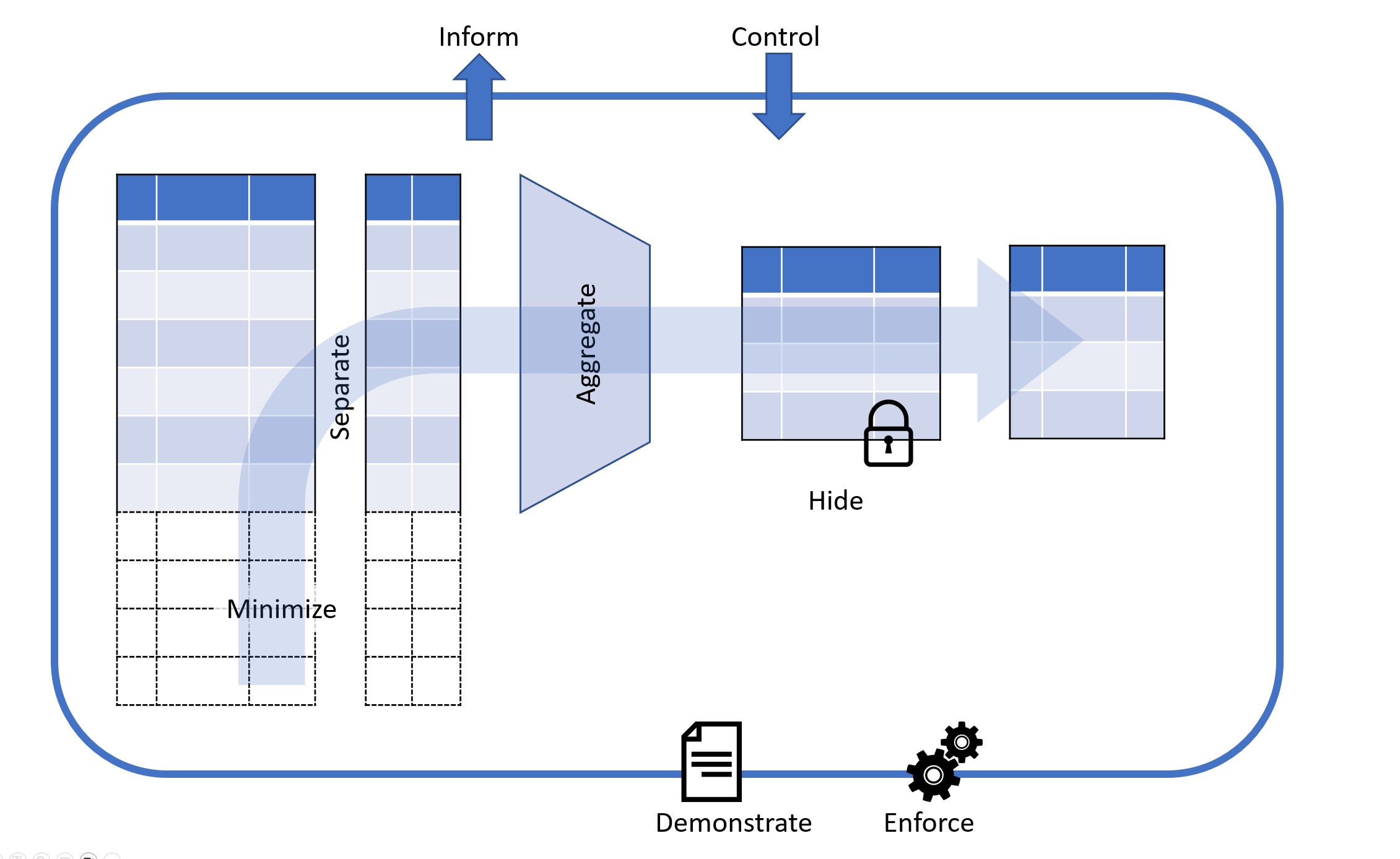
The diagram identifies eight principles, which are explained below.
Minimize
It is important not to store more data than necessary. That may seem obvious, but databases often contain data that is no longer used. In addition, data is frequently stored in multiple locations, even though an application does not always need to store it itself. In many cases, the application can retrieve the data from a source system whenever it is needed.
Separate
Separating data reduces the impact of potential data breaches and helps limit their consequences. For example, personal information such as names and addresses can be stored separately from data about how an application is used.
Aggregate
According to the GDPR, no more data should be retained than necessary. Suppose you want to know how often a particular action is performed within an application. You could log which user performs that action and when, allowing you to generate reports. However, it is also possible to record only how many times the action has been performed. By aggregating the data, individual information is no longer required.
Hide
This principle includes measures such as encryption and anonymization. To protect organizations and users against the loss of data, personal data should be encrypted. This applies both to data stored in a database and to data transmitted over secure connections, such as HTTPS. During anonymization, personal data is modified or separated from other data so that it can no longer be traced back to an individual.
Inform
The application should clearly indicate which data is being processed and why. Users should also be able to view their personal data.
Control
Users should have control over their personal data and be able to have it modified or deleted.
Demonstrate
Using logging and audit trails, the software should be able to demonstrate who has accessed or modified personal data and when this occurred. Whenever data is changed, it should be clear who made the change.
Enforce
It is essential that only authorized individuals have access to personal data. Effective access control is therefore crucial. Authorization and authentication should be implemented using proven and reliable methods. In addition, the organization should have policies in place that define and enforce which individuals are allowed to access, for example, production data.
By applying these eight principles during the design of software, the likelihood increases that an application is secure and complies with applicable laws and regulations. This benefits not only the organization, but also the individuals whose personal data is being processed.
Want to learn more about GDPR compliance, secure software development, or application security?
If you would like to learn more, feel free to contact us or discuss your specific situation.
More blog posts
-
Get more done with C# pattern matching
This blog provides a practical overview of C# pattern matching and shows how modern patterns can help make code more concise, readable, and maintainable.Content typeBlog
-
Storing JSON data in SQL databases
This blog explores how JSON data can be stored and processed within SQL Server and Azure SQL Database, and how the built-in JSON functionality enables flexible handling of schemaless data without constant database schema changes.Content typeBlog
-
Regex in SQL Server 2025 & Azure SQL
SQL Server 2025 introduces native regex support, simplifying pattern matching, validation, and data transformation with more readable, maintainable, and powerful queries compared to traditional string functions.Content typeBlog
Stay up to date with our tech updates!
Sign up and receive a biweekly update with the latest knowledge and developments.